
Physics can feel overwhelming at first. One minute you’re solving a simple motion problem, and the next you’re staring at symbols that look like they belong in a completely different language.
That’s why the AP Physics 1 equation sheet matters so much.
Many students think the equation sheet is just a reference page handed out during the exam. Technically, that’s true. But the students who score well usually see it differently. They treat it as a roadmap. Instead of memorizing dozens of disconnected formulas, they learn how the equations connect to real physical situations.
Here’s the thing: having the equation sheet available during the exam doesn’t automatically make the test easier. If you don’t understand what the equations mean, the sheet becomes a wall of symbols. If you do understand them, it becomes one of your most valuable tools.
Table of Contents
- What Is the AP Physics 1 Equation Sheet?
- Why the Equation Sheet Matters More Than Most Students Think
- Understanding the Kinematics Equations
- Forces and Newton’s Laws on the Sheet
- The Energy Equations You Must Know
- Momentum and Collisions Made Simpler
- Rotational Motion Formulas
- Simple Harmonic Motion and Waves
- Common Mistakes Students Make
- How to Study With the Equation Sheet
- Turning Formulas Into Physical Understanding
- Final Thoughts
What Is the AP Physics 1 Equation Sheet?
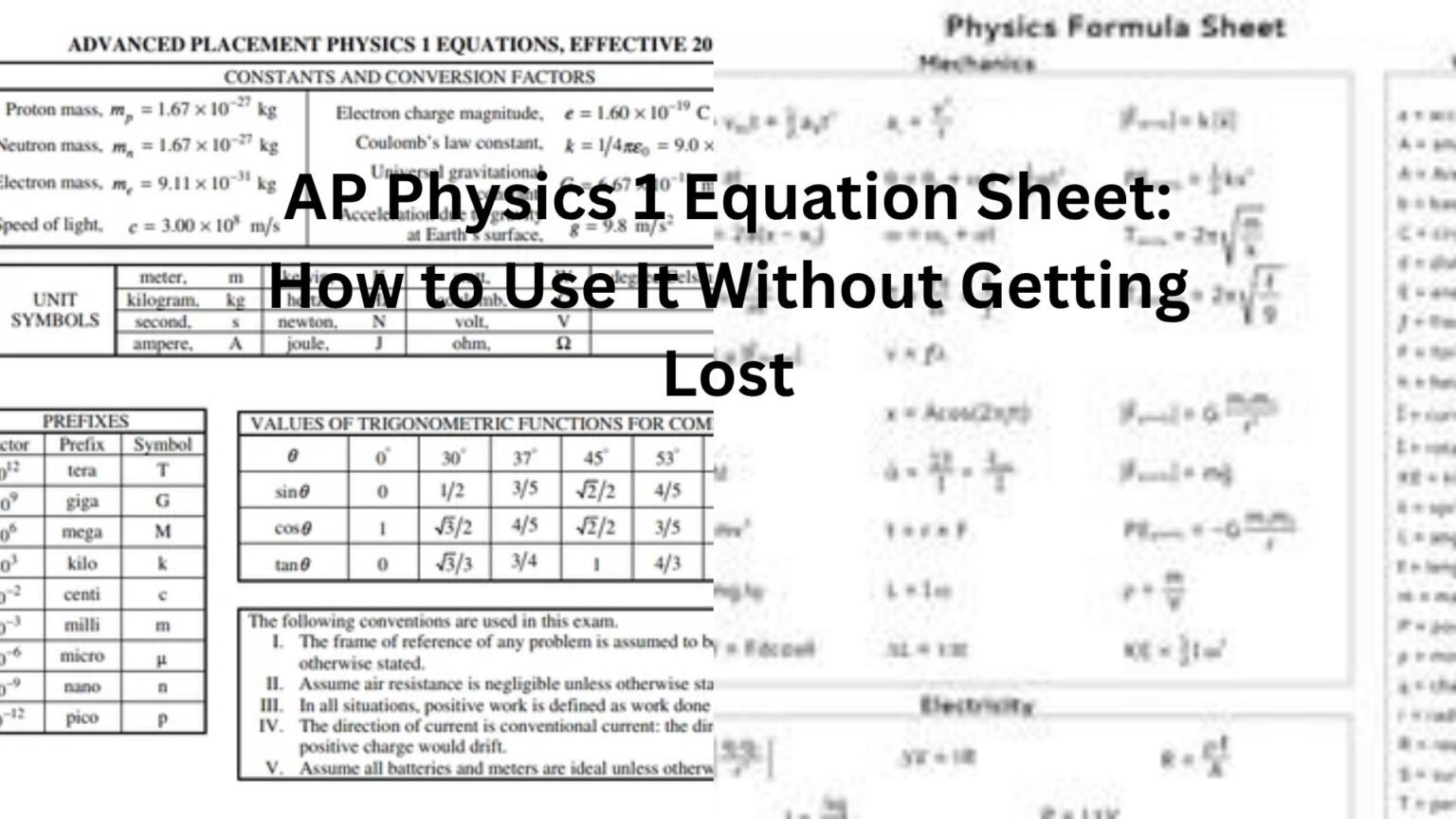
The AP Physics 1 equation sheet is a formula reference provided during the AP exam.
It contains the key equations covered throughout the course, including formulas related to motion, forces, energy, momentum, rotation, and oscillations.
At first glance, it may seem like a giant cheat sheet. Many students breathe a sigh of relief when they discover they won’t have to memorize every formula.
That relief can be misleading.
The exam isn’t designed to test whether you can locate an equation. It’s designed to test whether you know when and why to use it.
Imagine someone gives you a toolbox filled with professional equipment. If you’ve never used a wrench before, the toolbox won’t magically help you fix a car. The same idea applies here.
Why the Equation Sheet Matters More Than Most Students Think
Let’s be honest. Most students spend too much time memorizing formulas and not enough time understanding concepts.
Physics rewards understanding.
When a problem describes a skateboard rolling down a ramp, the test isn’t asking whether you remember a formula. It’s asking whether you recognize the physical principles involved.
The equation sheet helps you focus on those principles.
Instead of worrying about recalling every symbol perfectly, you can spend your energy analyzing the situation. That’s where the real points are earned.
Many high-scoring students report something interesting. By exam day, they barely needed to look at the equation sheet because they had used it so often while studying.
That familiarity matters.
Understanding the Kinematics Equations
Kinematics is usually where students begin their AP Physics journey.
These equations describe motion without worrying about what causes that motion.
You’ll see formulas involving:
- Position
- Velocity
- Acceleration
- Time
Think about a car accelerating away from a traffic light.
The driver presses the gas pedal. The car speeds up. Kinematics helps describe exactly how the velocity changes over time.
One common mistake is treating every motion problem as a formula-matching exercise.
Instead, start by asking questions:
What is moving?
Is the object speeding up?
Is it slowing down?
Is acceleration constant?
Once those questions are answered, the appropriate equation often becomes obvious.
Students who rush directly to plugging numbers into formulas usually make more errors than students who spend thirty seconds analyzing the situation first.
Forces and Newton’s Laws on the Sheet
Newton’s laws sit at the heart of AP Physics 1.
Almost every major topic connects back to them in some way.
The famous equation:
F = ma
looks incredibly simple.
Yet it explains an enormous amount about the physical world.
Picture pushing an empty shopping cart across a grocery store parking lot. Now imagine pushing the same cart filled with bags of groceries.
The loaded cart accelerates less because its mass is greater.
That’s Newton’s Second Law in action.
The equation sheet includes force relationships that help describe:
- Gravity
- Friction
- Tension
- Normal force
Students often struggle because they focus on equations before drawing force diagrams.
A quick free-body diagram can save you from major mistakes.
A rough sketch usually reveals which forces matter and which ones don’t.
The Energy Equations You Must Know
Energy tends to be one of the most enjoyable topics because it allows you to solve problems from a completely different perspective.
Instead of tracking every force individually, you can look at how energy changes.
The equation sheet includes formulas for:
- Kinetic energy
- Gravitational potential energy
- Elastic potential energy
Imagine riding a bicycle down a hill.
At the top, you have plenty of gravitational potential energy.
As you descend, that stored energy transforms into kinetic energy.
Your speed increases naturally.
One of the most powerful ideas in physics is that energy doesn’t simply disappear. It changes forms.
Students who truly understand energy conservation often solve problems faster than those relying solely on force-based methods.
Here’s the thing.
When you’re stuck on a problem involving motion, asking yourself, “Can I use energy?” can sometimes unlock the solution immediately.
Momentum and Collisions Made Simpler
Momentum is another topic that seems intimidating until you connect it to everyday experiences.
A bowling ball rolling across a lane feels very different from a tennis ball moving at the same speed.
Why?
Mass matters.
Momentum combines mass and velocity into a single quantity.
The AP Physics 1 equation sheet includes momentum relationships and conservation principles that become especially useful during collisions.
Think about a game of pool.
One ball strikes another.
Momentum transfers between them.
The total momentum of the system remains conserved under the right conditions.
Many collision problems appear complicated because multiple objects are involved.
Breaking the situation into “before” and “after” snapshots usually helps.
Once you organize the information clearly, the math often becomes surprisingly manageable.
Rotational Motion Formulas
Rotational motion introduces a new way of thinking.
Instead of objects moving in straight lines, they’re spinning.
At first, this section can feel like learning physics all over again because familiar ideas gain rotational counterparts.
Velocity becomes angular velocity.
Acceleration becomes angular acceleration.
Force connects to torque.
A playground merry-go-round provides a perfect example.
Pushing near the center doesn’t do much.
Pushing near the edge creates a much larger rotational effect.
That’s torque at work.
Students sometimes become overwhelmed by the number of symbols appearing in rotational motion equations.
Don’t panic.
Most rotational concepts mirror ideas you’ve already learned in linear motion. Once you recognize those parallels, the topic feels far less intimidating.
Simple Harmonic Motion and Waves
Some of the most visually satisfying physics concepts appear in this section.
Think of a swinging pendulum.
A vibrating guitar string.
A spring bouncing up and down.
These systems repeat their motion in predictable patterns.
The equation sheet includes formulas involving:
- Period
- Frequency
- Wave speed
- Oscillations
Music offers a great real-world connection.
When a guitar string vibrates, it creates waves that travel through the air and eventually reach your ears.
Physics explains every step of that process.
Students sometimes try to memorize wave equations separately from the rest of the course.
A better approach is understanding what the variables represent physically.
Once frequency and wavelength become meaningful concepts instead of symbols, the equations become much easier to use.
Common Mistakes Students Make
One of the biggest mistakes is assuming the equation sheet will do the thinking for you.
It won’t.
The sheet provides tools, not answers.
Another common issue involves ignoring units.
Units often reveal whether you’re on the right track.
If a problem asks for velocity and your final answer ends in joules, something has clearly gone wrong.
Many students also jump straight into calculations without identifying known and unknown quantities first.
That habit creates confusion.
Taking a minute to organize information usually saves time overall.
Perhaps the most damaging mistake is studying formulas in isolation.
Physics isn’t a collection of disconnected equations. It’s a network of related ideas.
Understanding those connections makes everything easier.
How to Study With the Equation Sheet
A surprisingly effective strategy is keeping the equation sheet beside you whenever you complete practice problems.
Use it constantly.
Highlight sections.
Make notes.
Become familiar with where everything appears.
Over time, you’ll stop searching for equations because you’ll naturally know where they are located.
Another useful technique involves covering the equations and trying to recall them before checking.
Not because memorization is required, but because retrieval strengthens understanding.
Practice explaining equations out loud.
For example:
“This equation relates force, mass, and acceleration.”
“This formula describes conservation of energy.”
Simple explanations often reveal whether you genuinely understand a concept.
Turning Formulas Into Physical Understanding
The strongest AP Physics students rarely view equations as math alone.
They see stories.
An acceleration equation describes a speeding car.
An energy equation describes a skateboard descending a ramp.
A momentum equation describes two hockey players colliding on the ice.
That mindset changes everything.
Instead of memorizing symbols, you’re understanding events.
Physics becomes less abstract and far more intuitive.
Whenever you encounter a formula, ask yourself what real-world situation it describes.
That question creates deeper understanding than hours of memorization.
Final Thoughts
The AP Physics 1 equation sheet is much more than a collection of formulas handed out on exam day. It’s a condensed summary of the core ideas that define the course.
Students often worry about remembering every equation, but success usually comes from understanding concepts rather than memorizing symbols. The equation sheet works best when it becomes familiar through regular practice and active use.
Treat each formula as a description of something happening in the real world. Connect motion to moving cars, energy to bicycles rolling downhill, momentum to pool balls colliding, and waves to music filling a room.
Once those connections start forming, the equation sheet stops looking like a page of random symbols. It becomes a guide that helps make sense of the physical world around you.