
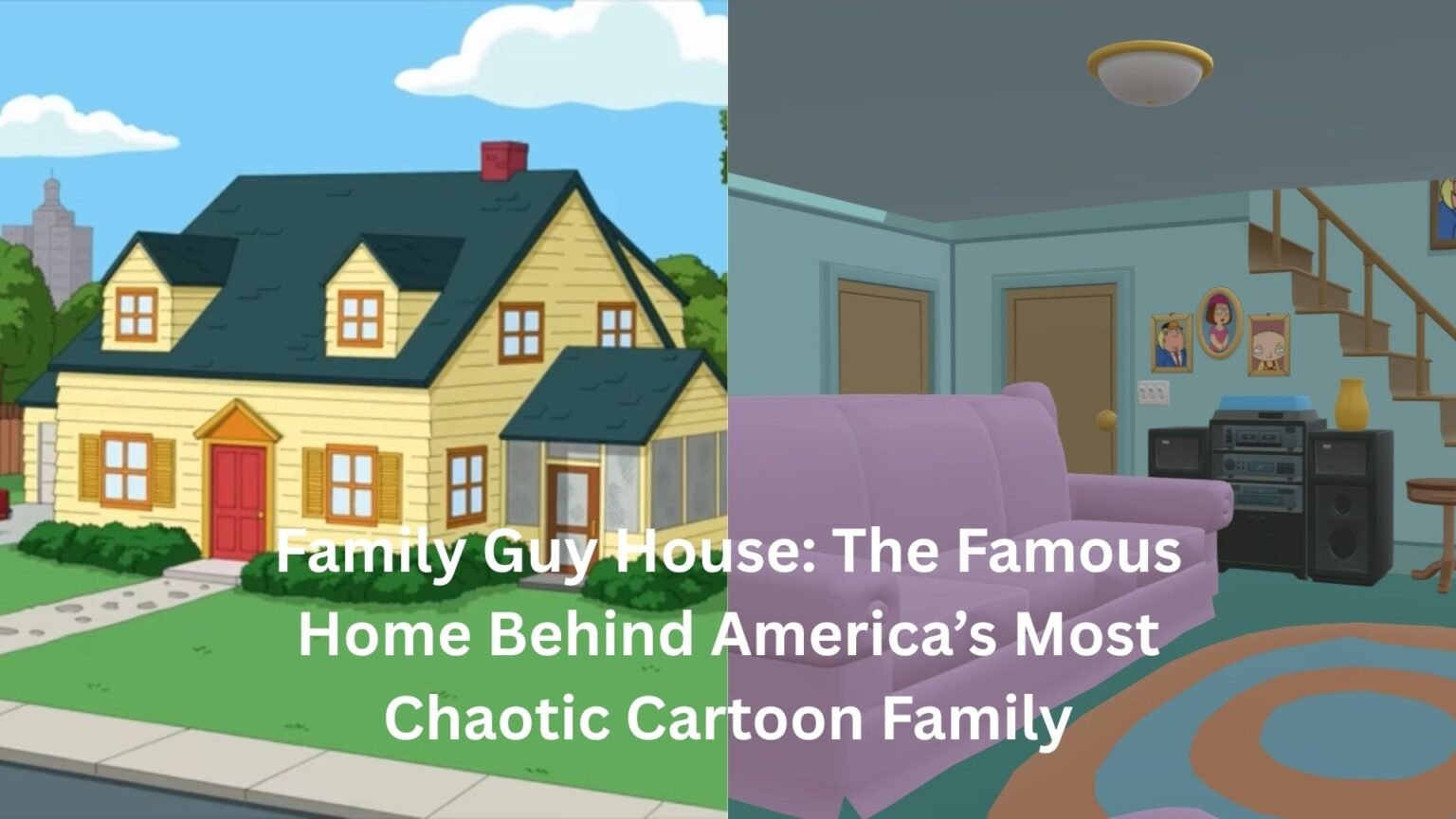
For a show packed with cutaway gags, giant chickens, and completely unpredictable storylines, it’s surprising how much of Family Guy revolves around one familiar place: the Family Guy house.
The Griffin family home isn’t just a background setting. It’s practically a character of its own. Fans can picture it instantly. The yellow exterior, the garage on the side, the living room with the famous couch, and the kitchen where countless bizarre conversations begin. Even people who haven’t watched every episode recognize the house within seconds.
That’s part of what makes it so interesting. While the show often jumps into absurd situations, the house provides a sense of consistency. No matter how strange things get, everything usually circles back to the Griffin family’s home in Quahog.
Let’s take a closer look at what makes the Family Guy house so memorable and why it remains one of the most recognizable homes in television animation.
The House That Holds the Entire Show Together
At first glance, the Griffin house looks like a fairly ordinary suburban home.
It’s located in the fictional town of Quahog, Rhode Island. From the outside, it resembles countless middle-class American houses built in suburban neighborhoods during the late twentieth century. There’s a front lawn, a driveway, a garage, and a simple two-story design.
Nothing about it screams cartoon madness.
That’s exactly why it works.
The contrast between the normal-looking house and the ridiculous events happening inside creates much of the show’s humor. One minute Peter Griffin is watching television on the couch. The next minute he’s involved in some impossible adventure that somehow started because of a casual conversation in the living room.
The ordinary setting makes the absurd moments feel even funnier.
Think about it like this. If the family lived in a giant castle or futuristic mansion, viewers would already expect strange things. Instead, the Griffin family lives in a house that feels familiar, which makes the chaos stand out.
A Tour of the Family Guy House Layout
One interesting thing about the Family Guy house is that its layout has become deeply familiar to longtime viewers.
Even though it’s animated, fans often know exactly where rooms are located.
The main floor contains the living room, kitchen, dining area, and hallway. The living room is arguably the most iconic space in the entire show. It’s where Peter spends countless hours watching television, arguing with family members, and launching conversations that drive episodes forward.
The couch facing the television has appeared in hundreds of scenes.
Just beyond the living room sits the kitchen, another central location. Lois often appears here preparing meals or trying to keep the family under control. Many of the show’s quieter family interactions happen around the kitchen table.
Upstairs are the bedrooms.
Peter and Lois share the master bedroom. Meg, Chris, and Stewie each have their own rooms, though Stewie’s bedroom gets far more attention than most children’s rooms in animated sitcoms.
That’s because Stewie’s room doubles as a secret laboratory.
Hidden within the walls are advanced inventions, time machines, weapons, and scientific experiments that somehow exist without alarming the rest of the neighborhood. It’s one of the funniest recurring contradictions in the series.
Stewie’s Room Changes Everything
If one room defines the Family Guy house beyond the living room, it’s Stewie Griffin’s bedroom.
On the surface, it looks like a normal nursery. Toys, books, and child-sized furniture fill the space.
Then viewers discover what’s hidden underneath.
Stewie regularly reveals secret laboratories equipped with technology far beyond anything seen in the rest of Quahog. He builds robots, creates time travel devices, develops mind-control equipment, and conducts experiments that would make professional scientists jealous.
Here’s the funny part.
The family rarely seems concerned about any of it.
That disconnect has become a signature element of the show’s humor. The audience knows Stewie possesses incredible technology, yet life inside the house continues as if nothing unusual is happening.
It creates a unique layer within the home. The Family Guy house appears ordinary from the outside but secretly contains one of the most advanced laboratories in television history.
The Living Room: Where Most Stories Begin
Every long-running sitcom has a central gathering place.
For Friends, it was the coffee shop. For The Simpsons, it was often the family living room. For Family Guy, the Griffin living room serves as ground zero for countless stories.
Peter sits in his favorite spot watching television.
Brian lounges nearby offering sarcastic commentary.
Lois attempts to maintain order.
Chris, Meg, and Stewie drift in and out.
Many episodes start with an everyday conversation that quickly spirals into something completely ridiculous. The living room acts as the launching pad for adventures, conflicts, and jokes.
Because viewers spend so much time there, the room feels surprisingly familiar.
If someone showed longtime fans a random screenshot from the living room, most could immediately identify the exact show without seeing any characters.
That’s a sign of effective visual design.
How the House Compares to Other Animated TV Homes
Animated sitcoms often rely on memorable homes.
The Griffin house shares some similarities with famous cartoon residences while maintaining its own identity.
Like the home in The Simpsons, the Griffin house represents a typical middle-class family environment. Both homes are designed to feel relatable despite the outrageous events happening inside.
The difference lies in tone.
The Simpsons house often feels slightly grounded, even during bizarre storylines. The Family Guy house functions more like a stage where absolutely anything can happen. One room may host a normal family dinner, while another becomes the site of a science-fiction adventure five minutes later.
The house adapts to whatever joke or storyline the writers want to tell.
That flexibility has helped keep the setting fresh for decades.
Why Fans Are Fascinated by the Family Guy House
There are plenty of reasons viewers continue discussing the Griffin home.
Part of the fascination comes from familiarity. After hundreds of episodes, the house feels almost like a real place.
Fans know where Peter usually sits.
They know where Stewie’s room is located.
They know the route characters take when running upstairs.
This repeated exposure creates a strange sense of connection.
It’s similar to visiting a favorite coffee shop every week. Eventually, you stop thinking about the layout because it becomes second nature. The Family Guy house achieves something similar through repetition.
Another reason fans enjoy analyzing the house is that its layout occasionally changes.
Like many animated sitcoms, the floor plan sometimes shifts to accommodate a joke or storyline. A room might appear larger than before. Hallways may seem to connect differently.
Most viewers don’t notice.
Dedicated fans, however, love spotting these inconsistencies and discussing them online.
The Exterior Design Is More Important Than It Looks
The outside of the Griffin house deserves more attention than it usually gets.
The simple suburban design communicates a lot before a single character speaks.
When viewers see the house, they immediately understand the setting. This is a middle-class American family living in a quiet neighborhood. The image creates expectations of normal suburban life.
Then the episode completely destroys those expectations.
That visual contrast strengthens the show’s comedic identity.
The exterior has remained remarkably consistent throughout the series. Even as animation quality improved over the years, the recognizable look of the home stayed largely intact.
Consistency matters.
Television audiences develop emotional connections to familiar environments. Keeping the house recognizable helps maintain a sense of continuity across seasons.
The House Reflects Each Family Member
One subtle strength of the Family Guy house is how it reflects the personalities of the people living there.
Peter’s influence appears everywhere through clutter, television-centered activities, and general disorder.
Lois brings structure and stability to the home, preventing complete chaos.
Chris’s room reflects his awkward teenage interests.
Meg’s spaces often highlight her role as the family’s overlooked member.
Stewie’s room showcases his intelligence, ambition, and endless schemes.
Even Brian’s presence shapes the atmosphere. As the family’s talking dog, he moves through the house almost like another adult resident rather than a pet.
Together, these details make the house feel lived in rather than simply drawn.
The environment tells stories even when characters aren’t speaking.
A Cartoon House That Feels Surprisingly Real
Here’s the thing.
The Family Guy house shouldn’t feel realistic.
A genius baby lives there. A talking dog writes novels. The father regularly survives situations that would be impossible in real life.
Yet the house itself creates a sense of reality.
The kitchen feels like a real kitchen.
The bedrooms feel like actual family bedrooms.
The living room resembles a space many viewers have experienced themselves.
That balance helps anchor the show. No matter how outrageous the jokes become, the familiar environment keeps viewers connected to the characters.
It’s a simple storytelling trick, but an effective one.
Final Thoughts
The Family Guy house is much more than a cartoon backdrop. It’s the center of the Griffin family’s world and one of the most recognizable homes in television animation.
Its ordinary suburban appearance creates the perfect contrast for the show’s unpredictable humor. From the famous living room couch to Stewie’s hidden laboratory, every part of the house contributes to the series in its own way.
After years of episodes, many fans know the Griffin home almost as well as they know the characters themselves. That’s a rare achievement for any television setting.
The next time you watch Family Guy, pay attention to the house. Beneath the jokes and chaos, you’ll find one of the smartest pieces of world-building in the entire series: a perfectly ordinary home where absolutely anything can happen.